
How To Measure a Shoe Insole: a step-by-step guide and size chart for adults
Effective Date: September 21, 2026
In this guide, we’ll walk you through the insole measuring process with maximum accuracy, so you can give your feet the comfort they truly deserve. The correct internal shoe length is essential for healthy walking. In the following lines, we will explain the differences between the terms, show you how to determine the actual insole length, and provide an overview of sizes based on the insole measurement.
What is an insole in a shoe?
Before you grab a measuring tape, it’s important to clarify the terms. What is an insole in a shoe? Many customers confuse it with the outsole (sole), but it is the inner part of the shoe that your foot stands on. This layer has several important functions: it absorbs impact, helps manage moisture and provides thermal comfort.
With quality brands such as Rieker or Tamaris, you’ll come across advanced technologies. For example, memory foam insoles mould to the shape of your foot after a short time of wear. In terms of construction, the inner insole can be either removable (so you can take it out and measure it) or firmly glued in place.
What is insole length?
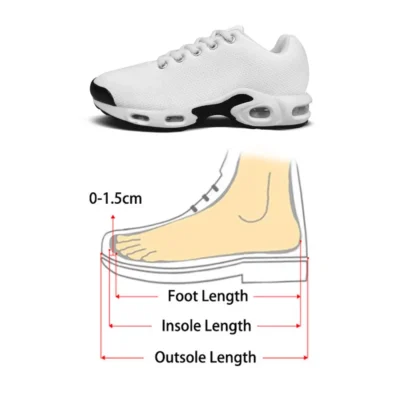
The term insole length refers to the total internal space of the shoe from the heel to the furthest point at the toe. It is not the same as the length of your foot. For shoes to be comfortable, the internal shoe length must always be longer than your foot. This difference is known as extra room (or shoe allowance), and it ensures that your toes have enough space while walking and don’t become compressed or deformed. What does insole length mean in practice? It’s the value you’ll find in manufacturers’ charts and the one used for choosing the right size based on your measurements.
How to accurately measure insole length and foot length
There are several methods to find the right measurement. Let’s look at how to measure insole length using an insole, as well as how to measure your foot directly.
How to measure the inside insole (insole method)
If you have a pair of shoes at home that fits you “perfectly,” you’re in luck. This is the quickest method.
Carefully remove the insole from the shoe.
Place it on a flat surface.
Use a tailor’s tape measure or a metal measuring tape.
Measure from the centre of the heel to the longest point at the toe.
This will show you the internal insole length that truly suits you. However, make sure the insole isn’t from overly worn shoes, where it may be compressed or deformed, which could distort the measurement.
Measuring your foot on paper (the most accurate method)
If you don’t have a removable insole, or if you want to check the current condition of your feet (which can change with age and weight), follow these steps:
Place an A4 sheet of paper against a wall and tape it down.
Stand on the paper so that your heel touches the wall. Distribute your weight evenly on both feet.
Trace the front of your foot with a pencil (keep the pencil vertical to minimise distortion).
Measure the distance from the edge of the paper to the furthest point (usually the big toe).
Add an extra allowance of 0 to 1.5 cm at the toe for comfort. The result is your required internal insole length.
Insole length chart by size (US & EU)
Looking for specific measurements for your size? We’ve prepared a detailed size overview by insole length (in inches) for both Women’s and Men’s shoes.
WOMEN’S SHOES
| US | EU | INSOLE LENGTH (IN) |
| 5.5 | 36 | 9.44 |
| 6 | 37 | 9.71 |
| 7 | 38 | 9.97 |
| 8 | 39 | 10.23 |
| 9 | 40 | 10.5 |
| 10 | 41 | 10.76 |
| 11 | 42 | 11.02 |
| 11.5 | 43 | 11.29 |
MEN’S SHOES
| US | EU | INSOLE LENGTH (IN) |
| 5 | 38 | 9.97 |
| 6 | 39 | 10.23 |
| 7 | 40 | 10.5 |
| 7.5 | 41 | 10.76 |
| 8.5 | 42 | 11.02 |
| 9.5 | 43 | 11.29 |
| 10 | 44 | 11.55 |
| 11 | 45 | 11.81 |
| 12 | 46 | 12.07 |
| 13 | 47 | 12.36 |
| 14 | 48 | 12.63 |
Whether you’re looking for a size 39 or 40, we always recommend checking the specific size chart on the product page in the e-shop so you can choose the right size.
Insole length in inches – quick guide (from 9.44″ to 12.63″)
Sometimes you know the exact measurement in inches and need to find the size. Choosing your size by this measurement is one of the most reliable ways to shop online. Here’s a quick guide based on insole length:
9.44″ to 9.71″: Corresponds to Women’s EU 36 to EU 37.
9.97″ to 10.23″: Corresponds to Women’s EU 38 – 39 or Men’s EU 38 – 39.
10.5″ to 10.76″: Corresponds to EU 40 – 41 (for both Men and Women).
11.02″ to 11.29″: Corresponds to EU 42 – 43 (for both Men and Women).
11.55″ and above: Corresponds to larger Men’s sizes from EU 44 up to EU 48 (which is 12.63″).
If your measurement falls in between sizes, always choose the larger size. You can adjust a slightly larger shoe with an insole, but a shoe that is too small cannot be enlarged.
FAQ: Frequently asked questions about measuring insoles
How do you measure an insole if it can’t be removed?
In this case, use a tailor’s tape measure and carefully slide it into the shoe all the way to the toe, then press it against the heel. An alternative is to use a skewer: cut it exactly to the length of the space for your foot, then measure it with a ruler.
What is the ideal amount of extra room in a shoe? In a standard size guide chart, the clearance from the tip of the toes to the tip of the shoe (from foot length to outsole length) is recommended to be between 0 and 1.5 cm. For sports shoes and winter boots, the allowance can be larger (closer to 1.5 cm) to accommodate thick socks. For children, the minimum extra room should be at least 1 cm, ideally 1.2–1.5 cm, to provide enough space for natural growth.
What is the inner insole, and is it different from foot length? Yes, it’s an important difference. Foot length is the measurement of your bare foot. The inner insole is the total space inside the shoe. Shoe size by insole length is determined by adding the recommended free space to your actual foot length.
How do you measure an insole in high heels?
The measurement is similar, but for insoles in high heels, the tape measure must follow the curve of the insole rather than measuring in a straight line. For pumps, choose a smaller allowance (about 3–4 mm) so the shoe doesn’t slip off your heel.
How can I tell if the insole is too short?
If your toes touch the front of the shoe when standing normally, the insole length inside the shoe is too short. You should always feel free space in front of your toes.
Sizing tip: If you are between sizes, we recommend sizing up for a relaxed fit. Need help? Email: [email protected]
Feel free to reach out using the below details.

